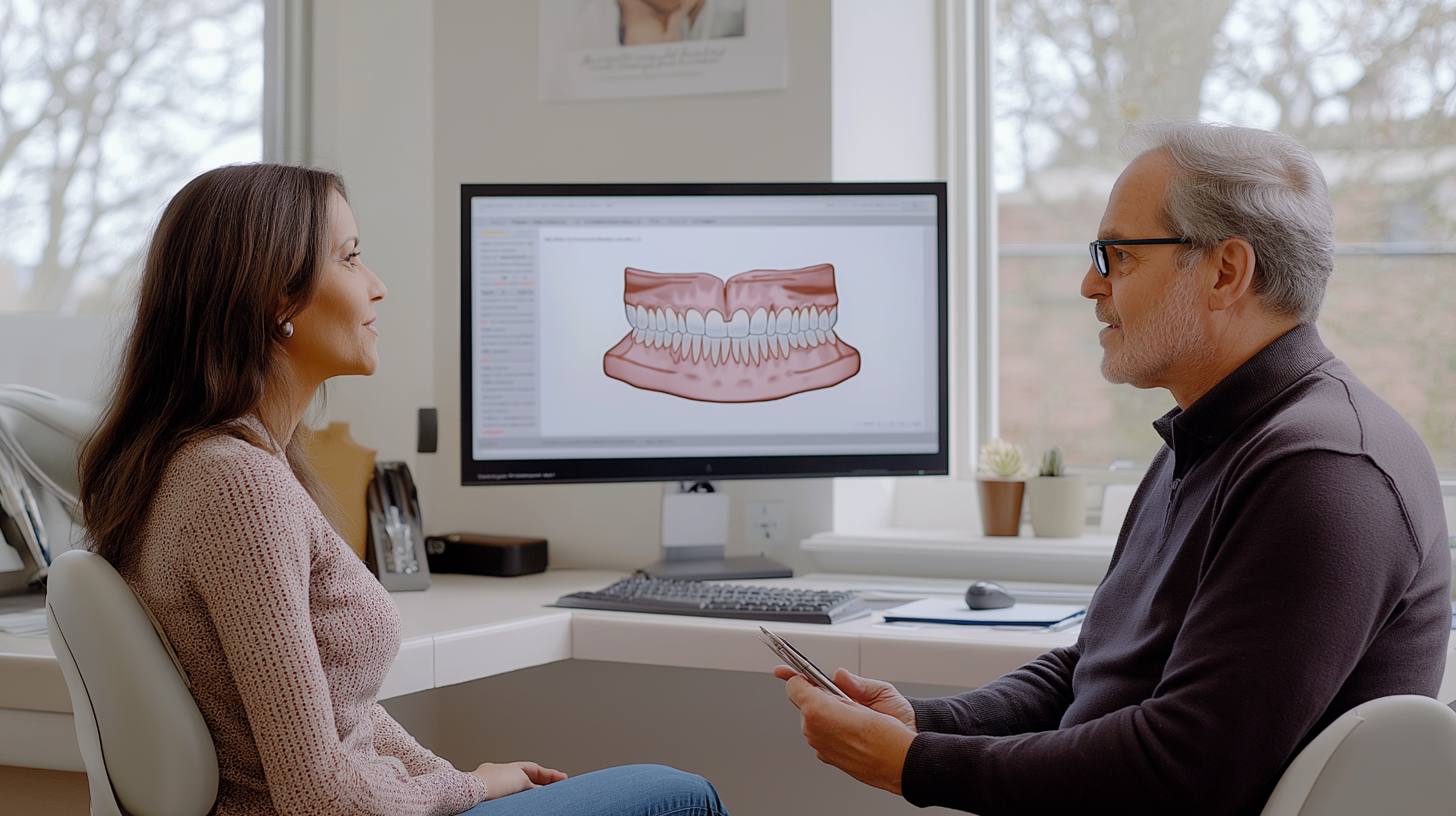
Most implant practices leave case acceptance to chance. Here are the five controllable factors that turn consultations into scheduled procedures.
You already know the math. A full-arch case is worth $40,000 to $60,000 or more to your practice. Two additional case acceptances per month can change your year. Ten lost consultations can quietly bury it.
Yet most practices treat case acceptance as a personality trait. Either the doctor "closes well" or doesn't. Either the patient "was ready" or wasn't. That framing turns a controllable business outcome into something that just happens to you. It also ignores the five distinct levers that influence whether a qualified patient actually moves forward, each of which can be optimized independently.
This post breaks down all five, explains why most practices only focus on one, and offers concrete changes you can make this month.
Why Do Implant Patients Say "Let Me Think About It" and Never Come Back?
The single most common outcome of an implant consultation is silence. The patient leaves, says they need to think about it, and never returns your follow-up call. Practices assume this means the patient wasn't serious, couldn't afford it, or got scared. Sometimes that is true. More often, the practice failed at one or more of the five levers below, and the patient simply lost confidence in moving forward with that specific provider.
Research from the American Academy of Implant Dentistry shows that over 3 million Americans currently have dental implants, with that number growing by about 500,000 per year. Demand is not the problem. The gap between interest and action is where case acceptance lives and dies.
Understanding that gap means looking at five distinct areas, not just your chairside close.
Lever 1: What Does the Patient Already Believe Before They Walk In?
Case acceptance starts well before the consultation. By the time a patient sits in your chair, they have already formed opinions about dental implants, your practice, and whether the procedure is realistic for them. Those pre-consultation beliefs are the first lever.
Pre-Education Through Content
Patients who arrive already understanding the basics of their treatment (what All-on-4 involves, what recovery looks like, what realistic pricing ranges are) convert at dramatically higher rates than patients who hear everything for the first time during the consult. The reason is straightforward: a one-hour consultation is not enough time to both educate and persuade.
Practices that publish honest, detailed content on their websites, covering topics like what All-on-4 recovery actually looks like or who qualifies as a candidate for full-arch restoration, are doing the educational work before the patient ever arrives. That means the consultation itself can focus on the patient's specific case, not on Implant Dentistry 101.
Third-Party Validation
Patients also research your practice through third-party sources before booking. They read Google reviews. They check your credentials. They look at directories and listings to see how you compare to other providers in the area. If your online presence is thin, or your only web footprint is your own website, you are asking patients to take your word for everything. Practices listed in independent directories like Dental Implant Directory give patients a way to verify credentials, read about specializations, and build confidence before the first phone call.
The takeaway: if your case acceptance rate is below where you want it, ask how much education and validation your patients are getting before they sit down with you.
Lever 2: How Well Does Your Consultation Address Fear, Not Just Facts?
Most implant consultations are structured around clinical information. The doctor explains the procedure, shows a scan, walks through the treatment plan, and presents the fee. That is necessary. It is not sufficient.
Full-arch dental implant procedures are among the highest-cost elective procedures in dentistry. Patients are not just weighing clinical facts. They are managing fear. Fear of pain. Fear of a bad outcome. Fear of spending $40,000 or more on something that might not work. Fear of being judged for letting their dental health get to this point.
Name the Fear Out Loud
The most effective consultation technique is also the simplest: acknowledge what the patient is feeling before you present the plan. Saying something as direct as "Most patients sitting where you are right now are nervous about cost, recovery, and whether this will actually work, and all three of those concerns are completely valid" does more to build trust than any clinical credential.
Show, Don't Just Tell
Before-and-after photos of actual patients (with permission) are more persuasive than any brochure. Video testimonials from real patients in your office outperform scripted marketing. If you have former full-arch patients willing to speak with prospective patients by phone, that is the single highest-converting asset any implant practice can deploy.

Lever 3: Is Your Financial Presentation Helping or Hurting?
Here is where most practices lose the most cases, and it is the lever that gets the least attention. The way you present cost matters as much as the cost itself.
The Lump-Sum Mistake
Presenting a full-arch case as a single number ("Your treatment will be $48,000") almost guarantees sticker shock. Even patients who can afford it will hesitate, because the human brain processes a single large number as a loss. Practices that break fees into phases, present monthly financing options alongside the total, and frame cost in context ("this is a permanent, fixed solution that replaces dentures for life") see measurably higher acceptance.
Financing Has to Be Framed, Not Just Offered
Saying "we offer financing" is not enough. Patients need to see what their monthly payment would actually be before they leave the office. If your treatment coordinator is not running financing scenarios during the consultation (not after, not in a follow-up email, but during the conversation), you are letting patients leave with only the big number in their head.
Many practices use third-party financing (CareCredit, Proceed Finance, LendingClub) but treat it as a fallback. The highest-performing practices present financing as the default framing: "Most of our full-arch patients choose a monthly plan. Here is what that looks like for your case." This normalizes financing and removes the stigma some patients feel about needing it.
Separate the Value Conversation from the Price Conversation
Present the treatment plan first. Explain what the patient gets: permanent teeth, the ability to eat normally, no more adhesives, no more embarrassment. Let that land. Then, in a separate part of the conversation (ideally with a treatment coordinator, not the doctor), present the investment. When value and price are delivered in the same breath, price wins every time.
Lever 4: What Happens in the 48 Hours After the Consultation?
This is the most neglected lever. Most practices consider their job done when the patient walks out. But the 48-hour window after a consultation is where the majority of case acceptance decisions are actually made, and it is where most practices go completely silent.
The Follow-Up System
Within two hours of the consultation, the patient should receive a personalized follow-up. Not a generic "thanks for visiting" template, but a message that references their specific situation. "Hi [Name], it was great meeting you today. I wanted to send over the treatment plan we discussed for your upper and lower arches, along with the financing options we reviewed. If any questions come up, I am personally available at this number."
Within 48 hours, a phone call. Not a text. Not an email. A call from the treatment coordinator asking if any questions came up since the visit.
Why Practices Skip This
Treatment coordinators are busy. Doctors are in procedures. Nobody owns the follow-up. The result: the patient who was 70% ready after the consultation drifts to 40% by Friday, and by the following week they have started researching other providers or talked themselves out of the procedure entirely.
The fix is a simple, non-negotiable checklist. Same-day personalized message. 48-hour phone call. One-week check-in if no decision. Two-week final outreach. Assign it to one person. Track completion. This lever alone can move case acceptance by 15% to 25%.
Lever 5: Does Your Online Presence Back Up What You Said in the Room?
After the consultation, patients go home and Google you again. They recheck reviews. They look at your site with fresh eyes now that they have a specific treatment plan and dollar amount to weigh. What they find either reinforces the confidence they built in your office or erodes it.
Reviews Matter More Post-Consultation
Before the consultation, reviews influence whether a patient books. After the consultation, reviews influence whether they schedule surgery. A practice with dozens of detailed, recent Google reviews from implant patients creates a sense of inevitability: "Other people did this, it went well, I should too." A practice with a handful of generic reviews or, worse, visible negative reviews about cost surprises or poor communication, gives the patient permission to hesitate.
If you are not actively requesting reviews from every completed implant case, you are leaving this lever untouched.
Directory Listings as Decision Reinforcement
Patients who are weighing a $40,000-plus decision will look beyond your website for confirmation. Being listed on a credentialed, specialty-specific directory gives them an independent source that validates what you told them in the chair. Your credentials, your specialization, your location, all confirmed by a third party. That kind of reinforcement matters when a patient is trying to justify a major financial commitment to themselves or a spouse.

How Do You Know Which Lever Needs Attention First?
Start by diagnosing where your patients are dropping off.
- If patients are booking consultations but not showing up, the problem is Lever 1 (pre-consultation beliefs). They are not arriving educated or confident enough to commit the time.
- If patients attend consultations but seem disengaged or overwhelmed, the problem is Lever 2 (consultation structure). You are presenting facts without addressing emotions.
- If patients say "I need to think about cost," the problem is Lever 3 (financial presentation). You are presenting price without context or options.
- If patients seem enthusiastic in the office but go dark afterward, the problem is Lever 4 (post-consultation follow-up). You are losing momentum.
- If patients consult with you and then choose a competitor, the problem is Lever 5 (online presence). Something they found after leaving your office changed their mind.
Most practices instinctively focus on Lever 2 (the consultation itself) because it is the most visible. But the highest-ROI improvements usually come from Levers 1, 3, and 4, which operate outside the exam room.
The Bottom Line
Case acceptance is not a single skill. It is a system with five distinct levers, each of which can be measured and improved independently. The practices that consistently close full-arch cases at high rates are not just better closers. They pre-educate patients before the visit, address fear alongside facts during the consult, present finances in a way that reduces friction, follow up with discipline in the 48 hours after, and maintain an online presence that reinforces every promise they made in the room. Fix the weakest lever first, and the numbers will move. And when you are ready to strengthen your online presence and connect with patients who are actively searching for qualified providers, list your practice on Dental Implant Directory.
Get found by implant patients
Join the directory and start receiving qualified inquiries in your area. Plans start at $8/month.
Explore Listing Plans